
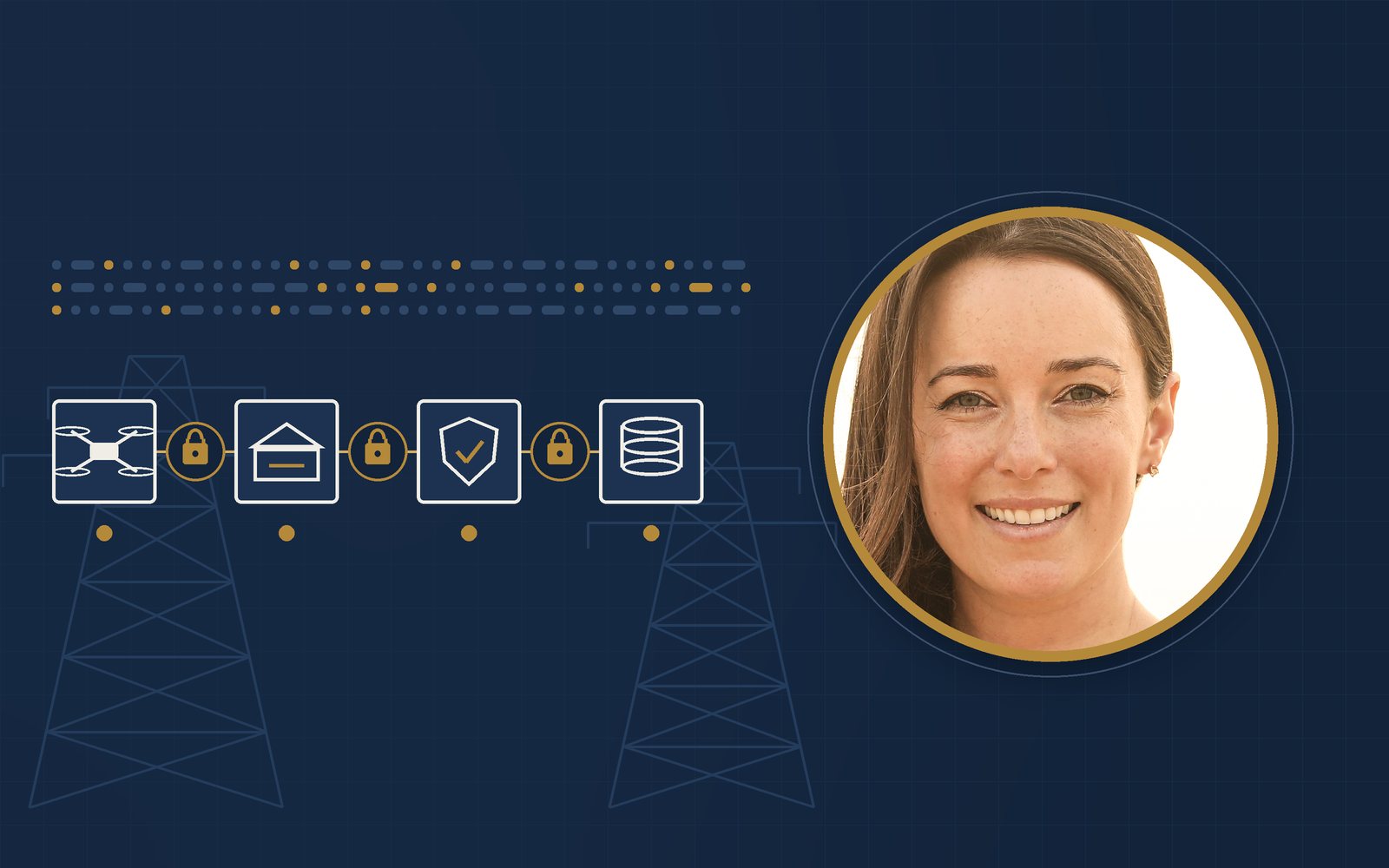
Presented at Commercial UAV Expo 2026 in Las Vegas as part of the session “Building Drone Programs That Hold Up in the Real World of Energy and Utilities.”
Utility drone programs rarely stall because the aircraft can’t fly the mission. They stall in the cybersecurity review — because no one can clearly explain how the data is protected from the moment it’s captured to the moment it lands on a utility network.
Protect the payload data
Inspection imagery isn’t just operational data. A leaked dataset of substations, lines, and towers lets an adversary map weak points in critical infrastructure. Leaked infrastructure data is a targeting aid, and under NERC CIP the regulatory exposure can reach seven-figure penalties, per violation, per day.
That makes security a systems integration problem, not a checklist. The practical way to approach it is to follow the data, end to end, and treat every handoff as a deliberate security boundary.
Step 1: Capture and onboard protection
Threat: an aircraft executes an emergency landing outside a secured landing zone.
Data should be encrypted at the point of capture, on the aircraft — AES-256 at rest, with keys that never travel with the data. A lost or captured airframe should not mean a compromised dataset.
- Ask your OEM: What protects data if the aircraft is stolen?
- OEM, provide: Encryption standard, key management, and hardware security capabilities.
Step 2: Aircraft-to-dock offload link
Threat: someone walks up with a tablet and tries to join the dock’s Wi-Fi network.
“Short-range” isn’t “trusted.” The offload link should use WPA3-Enterprise and TLS 1.3 with a token-based access policy, and it should authenticate every time.
- Ask your OEM: Is the handoff authenticated, or is any device trusted?
- OEM, provide: The authentication method for the offload link.
Step 3: The dock-side hardware gateway
Threat: a known vulnerability in the cellular modem’s firmware gives an attacker remote code execution.
WAN devices belong behind a hardware gateway, isolated from the LAN. Use mTLS, short-lived tokens, HSM-backed keys, and a DMZ for low-trust devices. No standing trust — every session is authenticated.
- Ask your OEM: What stops a compromised WAN device from reaching the payload computer directly?
- OEM, provide: What enforces the WAN/LAN boundary, and what sits on each side.
Step 4: Physical security of the dock
Threat: someone in a hi-vis vest walks up to the dock claiming to be on the maintenance schedule.
Cryptography is only as strong as the box it’s bolted to. Docks need tamper-evident, intrusion-sensing enclosures, restricted access, and video monitoring — and a physical breach should be treated as a trust-loss event.
- Ask your OEM: What happens if the dock is physically breached?
- OEM, provide: Tamper-response behavior on intrusion.
Key takeaways
A single unchanged default password anywhere in this chain undermines every other control. Every handoff is a security boundary, and the data deserves the same protection as the grid it describes.
The single most useful thing a utility can ask its OEM for: a one-page architecture map of every boundary, walking through this chain for their platform. If they can’t produce it, that’s your answer.
Working through a UAS security review? See how we help with UAS cybersecurity and compliance.